Bet The Founder
The world of venture capital frequently analyzes founders and their ideas through the wrong lens. Product-market fit always sounds like the right metric, but when the uncertainty is highest and the capital is most scarce (first checks, early rounds), it’s simply the wrong target. At pre-seed, there’s no real market definition and not even a […]


The world of venture capital frequently analyzes founders and their ideas through the wrong lens.
Product-market fit always sounds like the right metric, but when the uncertainty is highest and the capital is most scarce (first checks, early rounds), it’s simply the wrong target. At pre-seed, there’s no real market definition and not even a stable product. The only thing that you have (or don’t have) is a founder with a specific relationship to a problem. This relationship, which we call the founder–market fit, is the only thing early-stage funds can analyze and guarantee with confidence.
Why founders, not products, carry the option value
During the first weeks of a project, all the things that look like a “fact” about the product truly are “placeholders.” The founder can be confident about it, but reality and fit are still yet to be defined. The one and only reliable variable that an investor can look into is the founder’s learning rate, and their unfair access to truth and secrets about a space (either by affiliation or by great information). The markets always move, and a good founder should rotate with them. The products often have to pivot, and they should stay on track.
If you’re investing before “the Evidence,” which can be described as the product–market fit, you’re not buying revenues or performance (they don’t even exist), you’re buying the inevitability. The inevitability that something great is going to happen, that a change is going to occur.
The best sign of inevitability is a founder for whom the problem feels personal, something they understand instinctively and are already wired to solve. You can think of this idea of “product–market fit” as three edges:
- Earned secrets. A founder who lived experience with the problem. This yields hypotheses that are non-obvious and the reflex to test them quickly.
- Unfair access. A founder who already speaks the market’s language, who knows all the secrets of the space. This shortens the sales cycles and mistakes.
- Energy alignment. A founder whose work tastes like fun to him. This gives you the stamina to survive the long, boring parts when the outside world isn’t yet clapping.
Marc Andreessen’s classic theory that the only thing that matters is product–market fit is a powerful destination; it’s something that has to be reached. It’s just not a starting point, and the founder–market fit is. At the beginning, the only reliable map to that destination is the founder.
The Kima example: speed as a theory of people
If you want to see how this philosophy looks when it’s operationalized, look at Kima Ventures in France. The whole goal of Kima is to identify and back (great) founders fast: they are a team of four, investing €150k one-off tickets in around 120 deals per year, which is around two startups a week. That velocity forces a founder-first filter; there isn’t time to fetishize early product artifacts, only time to see if the team is capable of doing something big.
This founder focus extends to who runs the machine. Jean de La Rochebrochard, who manages Xavier Niel’s angel investing via Kima, frames the job as fighting to never miss a great founding team. In 2025, Kima now counts 1,200+ companies, 22 unicorns, 3 IPOs, and 174 acquisitions in its portfolio. This is real-world evidence that a high-tempo, founder-first strategy can truly compound.
And for a bit more general context on Kima: it was created in 2010 by Xavier Niel and Jérémie Berrebi, and in 2015 Jean took the lead and has been the founder magnet of the firm ever since. And the rule follows: if people determine early results, your process should maximize your exposure to them.
It’s not a rejection of the founder–market fit, it’s its purest form.
The most incredible founders are not just close to their market; they are close to reality, constantly adapting their understanding of it. What Kima funds, in practice, is the speed of that adjustment. Founder–market fit might be the compass, but learning is the motion that keeps the compass useful.
What founder–market fit looks like (and how to actually test it)
Early-stage VCs can hardly diligence new and evolving products; they should instead learn to recognize what founder–market fit looks like. And here are a few fast heuristics to spot it:
- Biography → Hypothesis. Can the founder turn their lived experiences and background into a testable theory of the user in two sentences, without slides?
- Language fluency. Do they naturally use the market’s native words (not all the pitch-deck jargon used to please VCs), and can they explain the same thing to a non-insider without losing precision?
- Illicit advantage. Can they point to a specific, unfair way to get into a market that others can’t easily replicate?
- Learning loop speed. Ask for the last three decisions they reversed, and look for half-lives measured in days. You shouldn’t be testing their accuracy; you should be testing their adaptability.
- Talent gravity. Look who has already followed them (ex-colleagues, customers as advisors, industry misfits). A strong FMF makes the right people gravitate around you.
- Problem patience. Does the work sound like something they’d do for free? (Because at the start, it often is.)
These are founder questions, not product questions. And that’s the whole point.
Founders will lead, products will follow.
Two potential objections (and why they don’t stick)
“But the market still matters!”
Of course it does. It even dominates returns over long-term horizons. But early investing is the art of finding the people who can grow into the right market. If you back the right founders, you will then get multiple shots on goal as they iterate into “the pull”, which Andreessen describes as the unmistakable signal that a startup has found something people truly want.
“Isn’t this just pattern matching?”
Bad FMF can become a caricature, yes. The “X industry needs X insider” idea is wrong. Great FMF is the product of earned insight and speed. And earned insight in the sense that plenty of incredible companies come from outsiders who had an obsessive curiosity and who became insiders.
What early funds should change
- Timebox product work, expand founder bandwidth. Replace all the deck theater with founder-led work sessions. Your goal shouldn’t be to grade their degree of mastery on Figma; your goal should be to sample how they think.
- Default to yes on people, let the product be a call option. Small, fast checks with explicit expectations to iterate generate more true options than waiting for synthetic certainty.
- Build processes that assume pivots. If you finance founders, you’ll celebrate the pivot instead of punishing it. Assume the founders are right and know what they have to do. If they have the FMF, they know better than you. You should be advising them through this process.
This is why Kima’s cadence is so instructive: a high-volume, small-ticket model only works if you’re genuinely investing in humans. And if you do that well, the long tail of outcomes can be very good indeed. (Kima has an IRR of more than 25% over the past 10 years, accounting for the past two years, which were way more complicated for all the industry.)
For founders: stop shopping for markets, start telling your origin
If you’re pre-seed, don’t fake certainty about a product that will most certainly be unrecognizable in six months. Investors know that you can’t have it all figured out in the first month of the project.
Instead, try to lead with why you are the inevitable solver here. Show your earned secrets, your access, your taste. The early investor that you want isn’t going to bet on your v1; he will bet that you’ll find the market that can’t stop pulling from you.
Conclusion
In the earliest days of a startup, reality isn’t fixed, it’s always moving. Slides are often guesses, metrics are full of noise, and the product is a sketch that will be crossed out and re-sketched plenty of times. The person is the only thing that you can really price. And if pre-seed exists to manufacture inevitability, the raw material is founder–market fit.
Move fast, write small checks, and expect pivots. Spend more time with founders, not reading decks. Kima’s cadence shows what happens when you live by this philosophy: the surface area for great people increases; the number of chances for product–market fit to emerge increases with it. The product–market fit is the destination (it should not be overlooked), but the founder–market fit is the compass. If you are looking for more outliers, don’t shop for certainty. Back the humans most likely to find it.
In other words: bet the founder.
Sources
Kima Ventures official site – data on model, ticket size, & cadence
(≈€150k tickets, ~120 startups/year, “2 startups a week”).
Source: https://www.kimaventures.com/
Sifted: “Kima Ventures’ Jean de La Rochebrochard on what makes a great founder” (2022) – confirmation of portfolio scale, approach, and Jean’s founder-first philosophy.
Source: https://sifted.eu/articles/brunch-kima-ventures-jean-de-la-rochebrochard
Business Insider : “Kima Ventures is the world’s most active angel investor” (2011) – founding context by Xavier Niel and Jérémie Berrebi.
Source: https://www.businessinsider.com/kima-ventures-interview-2011-3
Marc Andreessen, “The Only Thing That Matters” (2007) – primary source of the product–market fit concept and the “market pull” metaphor.
Source: https://pmarchive.com/guide to _ _ startups _part4.html
Internal Kima Ventures data (publicly cited by Jean de La Rochebrochard, 2025) – portfolio numbers (1,200+ startups, 22 unicorns, 3 IPOs, 174 acquisitions) and IRR figure.
Sourced from public investor communications and Jean’s LinkedIn posts.
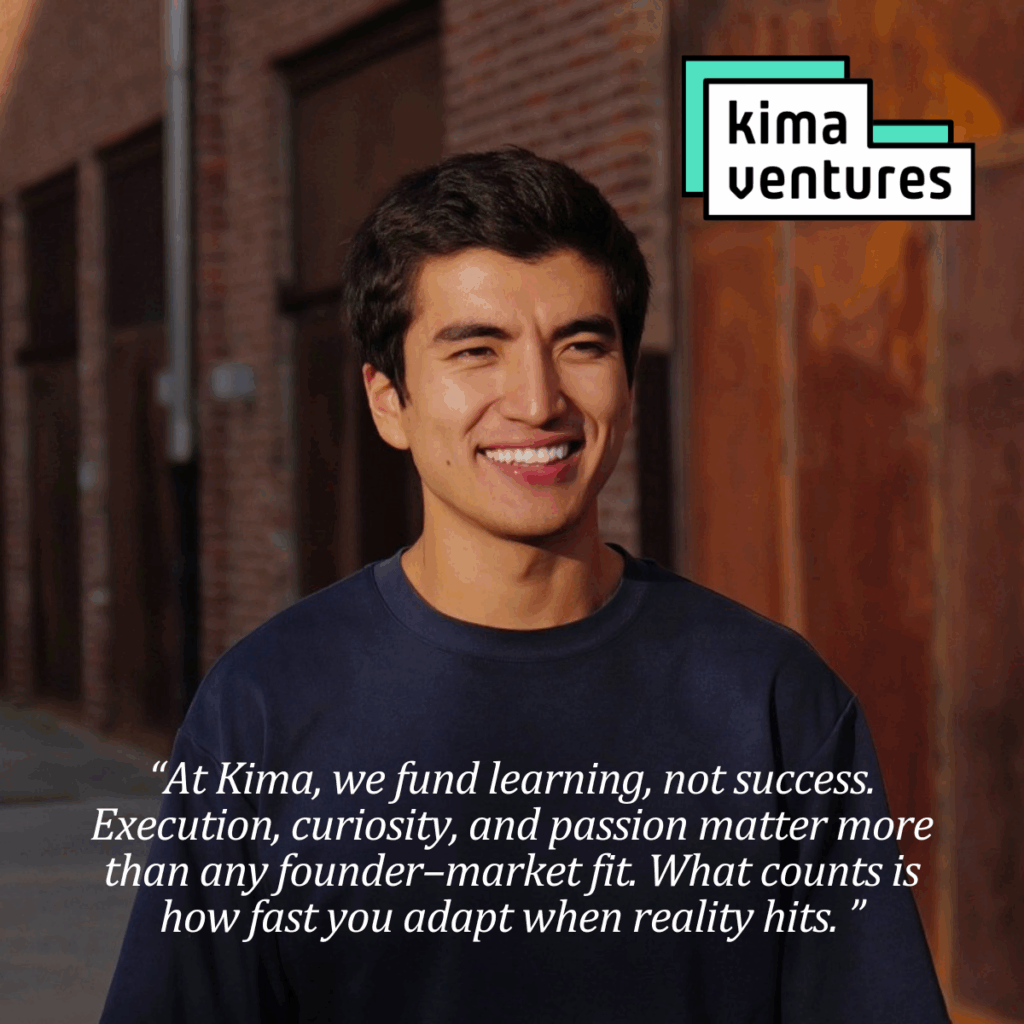
Direct contribution from Félix (Kima Ventures) – verified quote:
“At Kima, we fund learning, not success. Execution, curiosity, and passion matte