
Édito Dubai, or How to Sustain an Oasis in the Middle Eastern Inferno
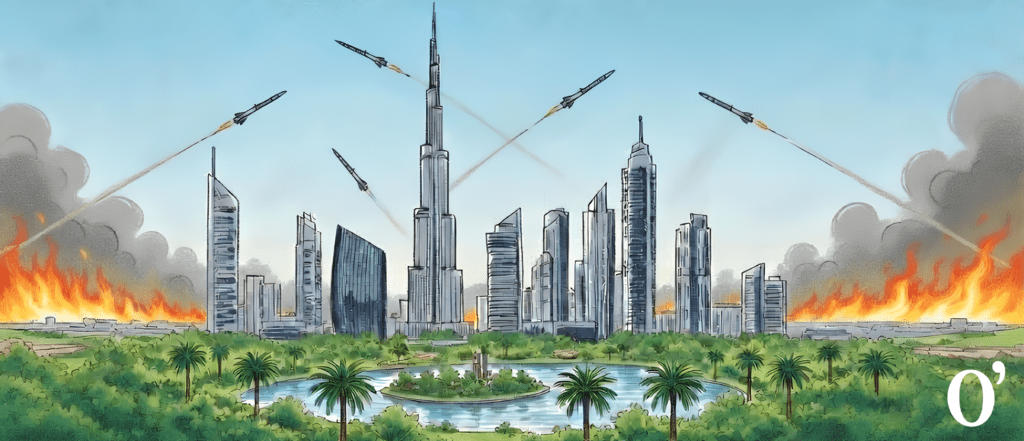
The Iranian retaliatory strikes of late February 2026, over 1,700 drones and missiles directed at the United Arab Emirates, acted as a brutal stress test on Dubai’s economic edifice. What had appeared to be an exemplary model of diversification turned out to rest on an infinitely volatile resource: the perception of security.

A model built on a fault line
In the space of forty-eight hours, the promise of half a century faltered. The Iranian retaliatory strikes of late February 2026, over 1,700 drones and missiles directed at the United Arab Emirates, acted as a brutal stress test on Dubai’s economic edifice. What had appeared to be an exemplary model of diversification turned out to rest on an infinitely volatile resource: the perception of security.
The numbers speak for themselves. Jebel Ali port, which alone accounts for roughly 36% of the emirate’s GDP, suffered fires in the wake of the strikes. Aviation, which generates 27% of GDP, was paralyzed: over 11,000 flights disrupted in Dubai, 20,000 canceled across the Gulf, a million travelers affected. The hotel sector, typically running at full capacity in a city that never sleeps, saw cancellation rates reach 80%, forcing establishments to slash their rates from 250 to 90 euros per night to attract the few remaining travelers. When the Dubai stock exchange reopened on March 4, after an unprecedented two-day suspension, the DFM (Dubai Financial Market) plunged 4.7%. According to local sources, TotalEnergies reportedly ordered its staff to leave, while Thales gave its teams the choice of whether or not to depart. The mood is one of caution – and mistrust.
The paradox is a cruel one for the economists who had celebrated the “Dubai miracle”: the neighboring states whose economies depend on hydrocarbons showed markedly stronger stock-market resilience. The Saudi exchange bounced back by 1%, Qatar’s rose 0.6%. After the well-known commodity trap, here then is the reputation trap.
To grasp the scale of the shock, one must return to the very architecture of the Dubai model. Over 95% of the emirate’s GDP comes from non-oil sectors, a figure long held up as a triumph of diversification. But that diversification did not reduce vulnerabilities – it displaced them. Dubai traded a dependence on commodities for a dependence on international confidence, on the physical flow of goods, on the presence of a highly mobile expatriate population, and on a reputation for stability in a region that has never truly been stable.
This is what some have called a “reputation economy”: a model whose value depends more on narrative than on geological or industrial fundamentals. When that narrative cracks, the fall is all the more abrupt. Closing the Strait of Hormuz does not merely threaten energy supplies – it severs all container traffic. In an instant, the global hub becomes an island.
The emirate’s demographic structure adds a further dimension to this risk. With 88 to 90% expatriates – a proportion unmatched among the world’s major financial centers – Dubai has an extremely mobile population. Unlike Singapore, which in the 1990s pursued a deliberate policy of anchoring its qualified foreign workforce, or Hong Kong, whose critical mass of permanent residents cushioned successive shocks, Dubai has yet to solve the fundamental equation: how to convert an inherently transient labor force into stable capital?
The point here is not to condemn a model that has, in the past, demonstrated a remarkable capacity for recovery – after the 2008 financial crisis, after the 2020 pandemic. But the current challenge is of an entirely different nature: How do you sustain a haven of peace in a recurrent Middle Eastern inferno?
Loosening the Hormuz chokehold
The first vulnerability is geographical: Jebel Ali is a Gulf port, accessible only through the Strait of Hormuz. The idea, then, would be to massively accelerate the Etihad Rail project and the UAE–Saudi Arabia road corridor toward Yanbu and Jeddah, enabling a complete overland bypass of Hormuz. This Trans-Arabian Corridor is not a new concept – it has featured on regional agendas since Saudi Vision 2030.
Meanwhile, the Port of Duqm in Oman is a deep-water facility located outside the Gulf, accessible from the Indian Ocean without transiting Hormuz. Currently underutilized, it represents a considerable fallback logistics option, provided it is activated through a formalized bilateral UAE–Oman agreement. Such an overflow architecture would have no equivalent in the region and would transform a well-known vulnerability into a negotiated comparative advantage. Precedents for emergency port cooperation in Southeast Asia show that such agreements can be operationalized quickly once the political will exists.
A longer-term consideration – but one whose financing the current crisis justifies bringing forward – concerns the physical protection of critical infrastructure. Singapore stores its strategic reserves (oil, munitions, data) in underground caverns beneath Jurong Island, shielded from any conventional strike. Dubai should consider a similar program for Jebel Ali: overflow berths built as underground infrastructure, buried aviation fuel reservoirs, and hardened.
A financial architecture in the service of resilience
Beyond logistics, Dubai has a comparative advantage: its financial ecosystem. The DIFC brings together some 300 international banks and several hundred asset management funds. It is a capital-mobilization infrastructure without equal in the region, and it can be put to work in the service of a resilience-financing strategy.
The first avenue would be the issuance of a Dubai Resilience Bond, modeled on Israeli war bonds or Ukrainian solidarity bonds issued in 2022. Israeli war bonds, issued intermittently since 1948 through the Israel Bonds program, have raised over $50 billion to date, primarily from the global Jewish diaspora. Their mechanism rests on strong identity-based attachment, a full sovereign guarantee, and yields slightly below market – subscribers accept a yield sacrifice in exchange for an act of solidarity. If Dubai, given what it represents, can build a similar system, it would have an unprecedented resilience-financing instrument in the Gulf – backed not by identity-based solidarity but by the confidence that markets place in its economic model.
The second avenue concerns insurance. One of the most immediate bottlenecks identified in the current crisis is the risk of surging insurance premiums for new real estate and infrastructure projects – a freeze that can durably paralyze a sector representing a third of GDP. The creation of a sovereign guarantee fund acting as reinsurer of last resort for regional geopolitical risks could provide a solution. In the event of a sudden spike in premiums beyond a defined threshold, the fund would step in to absorb the “exogenous shock” portion of the premium and maintain project insurability at economically viable rates. Dubai would thus become the first Gulf state equipped with a macroeconomic buffer of this kind. Similar mechanisms already exist in other contexts, such as the British Pool Re (terrorism risk) or France’s GAREAT (Gestion de l’Assurance et de la Réassurance des Risques d’Attentats et d’Actes de Terrorisme).
The third avenue is based on the observation that a regional crisis is a net capital-attraction opportunity. Capital flees instability, to be sure, but it also seeks safe jurisdictions to fall back to. The DIFC (Dubai International Financial Centre) should launch an accelerated emergency domiciliation program for financial entities forced to leave Beirut, Tel Aviv, or other weakened hubs in the region. For instance, a DIFC Emergency Residency status, with temporary tax relief and guaranteed business-continuity infrastructure, would turn the crisis into a driver of attractiveness. The logic is one of inter-jurisdictional competition during periods of turbulence – something Hong Kong long exploited and Singapore continues to practice methodically. The goal is to capitalize on what Dubai already has – a proven regulatory framework – and turn it into an institutional refuge at the very moment other jurisdictions falter.
Becoming the “Switzerland of the Middle East”, diplomatically
The emirate simultaneously maintains commercial and diplomatic relations with Iran, Israel, the United States, China, and India – a configuration that virtually no other global financial center can claim to have sustained amid growing international polarization. Cities like Oslo and Minsk have demonstrated that the status of negotiation venue confers implicit protection. In recent years, Dubai has hosted economic forums bringing together delegations of radically incompatible political origins. The idea, then, would be to strengthen this position.
The most ambitious path – and probably the most promising over the long term – would be to codify this neutrality within an international legal framework. Inspired by Geneva’s status for humanitarian institutions or Swiss neutrality in armed conflicts, such a framework could take the form of a coordinated approach to the United Nations for a resolution recognizing Dubai as a guaranteed neutral commercial zone – a diplomatic shield that belligerents would collectively have an interest in respecting, precisely because their own financial flows transit through it. Iran itself channels considerable economic interests through Dubai’s commercial structures.
In the nearer term, Dubai could propose that a U.S.–EU–India–China quartet sign a protocol guaranteeing freedom of commercial transit in the Gulf, with the emirate as an explicitly named beneficiary. Each of these powers has direct, documented interests in the continuity of Jebel Ali’s operations – in terms of energy supply, logistics chains, and financial flows. Such a collective deterrence architecture would be structurally more robust than an implicit reliance on the American security umbrella alone, and politically more acceptable for an emirate that cannot, by definition, pick sides in a global polarization it did not provoke.
The demographic question
With 88 to 90% expatriates, no major global financial center has demographic exposure of this kind. This population fluidity, which is a genuine advantage in times of growth – the emirate can quickly import whatever sectoral skills it needs – becomes a systemic vulnerability the moment the sense of security collapses.
The long-term answer requires a deep transformation of the relationship to residency. Dubai should launch a program for the massive conversion of temporary residencies into long-term ones, substantially expanding the rights attached to the ten-year Golden Visa: extended property rights, access to an investment fund reserved for long-term residents, and the beginning of a pathway toward conditional naturalization for qualified individuals in strategic sectors. Singapore made this transition in the 1990s; it became one of the structural foundations of its resilience during subsequent crises. The comparison deserves to be taken seriously, even if the cultural and institutional differences between the two city-states are real.
In the short term, more targeted incentive mechanisms can be envisioned without waiting for so deep a reform. Visas with progressive financial benefits, whose value increases with length of residency, would create economic loyalty where civic loyalty does not yet exist. The challenge is not so much to retain everyone as to retain those whose presence is essential to the functioning of critical infrastructure – the operators at Jebel Ali, the executives at Emirates, the developers at the data centers that power the emirate’s digital economy.
The intangible economy as a resilience architecture
A drone cannot bomb an algorithm. One promising avenue would be the export of the emirate’s legal framework, its tax structures, and its arbitration mechanisms as services for global companies operating outside the region. Dubai has a sophisticated Common Law framework through the DIFC and an internationally recognized commercial arbitration infrastructure through the DIAC (Dubai International Arbitration Centre). These assets can be exported – directly competing with Singapore and London in the international arbitration and domiciliation market – in a manner entirely uncorrelated with the physical risks bearing on the territory. The creation of zones hosting companies domiciled in Dubai but operating entirely outside the region would extend this logic: transforming Dubai from a geographic location into a regulatory platform whose value is independent of its geography.
On the economic-sector front, two areas deserve particular attention. The first is the digital economy and artificial intelligence. Microsoft Azure, Google Cloud, and Amazon AWS already have a presence in Dubai. The flexible regulatory framework of the DIFC and the ADGM (Abu Dhabi Global Market) is a genuine competitive differentiator for attracting AI players seeking a stable Middle Eastern jurisdiction. Digital GDP escapes the logic of physical vulnerability.
The second area is passive defense technology and cybersecurity. A city that generates a growing share of its GDP around systems-security technology – counter-drone, financial cybersecurity, space intelligence -mechanically positions itself as a partner that military powers have an interest in seeing thrive. EDGE Group, Abu Dhabi’s defense conglomerate, and potential partners such as Thales or American firms in the sector are natural anchor points for such a cluster. The drone threat can become an economic growth pillar for the emirate that chooses to treat it as a market rather than an inevitability.